
Convenience Store Merchandising: Win the 4-Minute Trip
A convenience store shopper gives you about three and a half minutes. A NACS Speed Metrics Study clocked the average trip, car door to car door, at 3 minutes 33 seconds. More recent NACS research says most transactions still finish in under four minutes, even with more foodservice in the mix.
That is the entire window for convenience store merchandising to do its job. In a grocery store, a shopper wanders, compares and reads labels. In a c-store, they walk in with a mission, scan for it, grab it and leave. Every display either helps that trip or slows it down.
The good news: a short trip is not a closed trip. NACS data shows 60% of consumers say a top reason to go inside is to browse, and 51% say a c-store visit gives them a moment to relax. The shopper is open to one more item. Your merchandising decides whether they see it in time.
This guide covers how the 4-minute shopper behaves, the c-store merchandising tips that fit that behaviour, the c-store displays that earn their space, and how to prove which ones work across every store you serve.
How the 4-minute shopper actually shops
C-store shoppers are mission-driven, impatient and buying for right now. Merchandising that ignores any of those three traits loses the sale.
- They come in for one thing. Most trips start with a fixed mission: a cold drink, coffee, a snack, cigarettes, a lottery ticket or something to eat. The first job of the store is to make that mission effortless.
- They buy for the next hour. NACS has reported that 84% of items bought at c-stores are consumed within an hour. Merchandise for immediate use, not the pantry.
- They split into two speeds. In NACS’s Time To Shop report, 45% of customers were in and out with a purchase in under 3 minutes, while 21% stayed more than 5 minutes, mostly for prepared food. Your layout has to serve both without one blocking the other.
- They punish friction. Mashgin data cited by NACS found 64% of shoppers would leave without buying because of a long line. A cluttered aisle or a display that blocks the path does the same damage.
The takeaway for merchandisers: don’t fight the mission. Attach to it. The best add-on sale sits directly on the path the shopper was already walking.
7 c-store merchandising tips built for speed
- Map the mission paths first. Walk the three most common trips: door to cooler to counter, door to coffee to counter, and pump customer straight to counter. Everything high-margin should touch one of those paths.
- Keep the cooler at the back, and make the walk pay. The cold vault pulls shoppers through the store. Line that route with salty snacks, jerky and candy that pair with a drink, so the walk back feels like a shortcut, not a detour.
- Protect sightlines from the door. A shopper should see the cooler, the coffee bar and the counter within two seconds of walking in. Keep floor displays below eye level near the entrance and keep aisles clear for two people to pass.
- Merchandise by need state, not just by category. Group items the way people use them: “breakfast on the go” (coffee, pastry, bars), “road trip” (big drinks, jerky, gum), “lunch” (sandwich, chips, drink). Need-state sets make the second item obvious.
- Put your best eye-level space to work. Eye level is buy level. Reserve it for high-velocity and high-margin SKUs, and use the bottom shelf for multi-packs and value sizes.
- Price clearly and visibly. A shopper on a four-minute clock won’t hunt for a price or ask. Clear shelf tags and bold deal signage (“2 for $5”) remove the last reason to put an item back.
- Keep it full, faced and clean. An empty facing or a messy shelf is the fastest way to lose a sale that was already decided. Make facing and restocking part of every shift, not a weekly task.
C-store displays that earn their space
In a small box, every display has to pay rent. These are the c-store displays that consistently do, and what makes each one work.
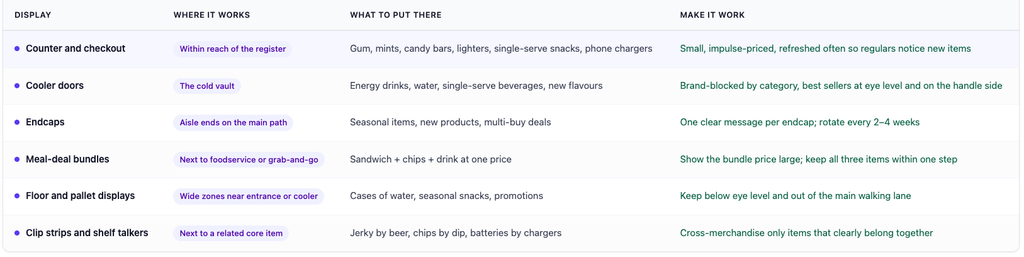
Two rules apply to every display. First, it must not slow the trip; a display that blocks the cooler or the counter costs more than it earns. Second, it needs a clear owner and an end date, or it becomes clutter by month two.
From good ideas to proven results: measure what’s on the shelf
The tips above only pay off if they actually happen in every store, every week. That is where most c-store programs break down. A planogram is designed at head office, emailed as a PDF, and then executed differently in each of hundreds of small-format stores.
For CPG brands and c-store chains, three things close that gap:
- One source of truth for planograms. Each store needs the right schematic for its size and fixtures, and the latest version only. A central planogram repository ends the “which PDF is current?” problem.
- Photo-verified compliance. Field reps and store staff capture shelf photos, and image recognition checks them against the planogram: missing facings, wrong placement, out-of-stocks and display execution. Problems surface in hours, not at the next audit.
- Store-level analytics. When compliance data sits next to sales data, you can see which displays and resets actually lift sales, and which stores need attention. That turns merchandising from opinion into evidence.
This is the work Analyticsmart is built for. Its Application de merchandising gives field teams task management, photo audits and AI-powered compliance checks, while its Planogram Repository and category management services make sure the right plan reaches the right store. The result: c-store merchandising you can execute fast and measure across your whole network.
Quick audit: is your store built for 4 minutes?
Walk your store with a timer and check:
- From the door, I can see the cooler, coffee and counter within two seconds.
- The path to the cooler is lined with items that pair with a drink.
- Eye-level space holds the top sellers and highest-margin SKUs.
- Every display has a clear price and a single message.
- No display blocks the main path, the cooler doors or the counter.
- Meal-deal items sit within one step of each other.
- Endcaps and counter items changed in the last 4 weeks.
- Shelves are full and faced at peak hours, not just after delivery.
- We have photo proof that the current planogram is in place.
Common mistakes to avoid
- Too many displays. Clutter slows the trip and hides the items you want seen.
- “Set it and forget it” endcaps. Regulars visit several times a week; stale displays become invisible fast.
- Ignoring the fuel-only customer. Pump shoppers who come in to pay are your easiest add-on sale. Merchandise the counter for them.
- Measuring sales without measuring execution. If you don’t know whether the display went up, you can’t know whether it worked.
Win the trip, one minute at a time
Convenience store merchandising is a race against the clock. The shopper decides fast, so the store has to be clear, full and built around the trips people already make. Put add-ons on the mission path, keep displays few and fresh, and make every price obvious.
Then prove it. The chains and brands that win in c-stores are the ones that know, store by store, what is actually on the shelf and what it is selling.
Ready to see your c-store execution clearly? Book a demo of the Analyticsmart Merchandising App and turn every planogram into a measurable result.
FAQ
What is convenience store merchandising?
Convenience store merchandising is how products, displays, pricing and signage are arranged in a c-store to make quick trips easy and drive extra purchases. It covers layout, planograms, cooler sets, counter items and promotional displays.
How long is the average convenience store trip?
About three and a half minutes. A NACS study measured 3 minutes 33 seconds from leaving the car to returning to it, and NACS reports most transactions still take under four minutes.
What are the best c-store displays for impulse sales?
Counter and checkout displays, cooler doors, endcaps on the main path and meal-deal bundles near foodservice. The best ones sit on the shopper’s existing path and show a clear price.
How often should c-store displays change?
Rotate endcaps and counter items every 2 to 4 weeks. Frequent shoppers visit several times a week, so displays go stale quickly.
How can brands check c-store merchandising compliance?
Use photo audits checked against the planogram, ideally with image recognition, and compare compliance with sales data. A merchandising app makes this fast across many stores.
