Merchandising in the Age of the Distracted Shopper
Your shopper has already decided before they reach your shelf. Here’s what that means for retail and CPG brands — and how data-driven merchandising wins back the moment that matters.
The three-second problem
The average shopper makes a purchase decision in under three seconds at the shelf. They are not reading your label copy. They are not comparing pack sizes. They are halfway through a mental to-do list that has nothing to do with your product — and somewhere between the parking lot and the checkout lane, they will make dozens of micro-decisions almost entirely on autopilot.
This is the reality facing every retail merchant and CPG brand manager today. Shopper attention has become the scarcest resource in physical retail. And for organizations that still treat merchandising as a logistics exercise — facing counts, compliance checklists, planogram resets — the cost of that misunderstanding is being felt at the shelf and on the P&L.
Why it’s getting harder — not easier
Retail has always competed for attention. But several forces have converged to make the in-store environment dramatically more challenging for both retailers and CPG suppliers.
Smartphones permanently altered shopper behavior. Consumers now walk aisles while checking messages, scrolling feeds, or comparing prices in real time. A growing share arrive with a list already built by an app or voice assistant — meaning the shelf is no longer where they discover, but where they confirm (or, if you’re lucky, where you interrupt their plan).
The SKU explosion has compounded the problem. Across food, beverage, beauty, and household goods, the proliferation of variants, flavors, sizes, and formats means that more choice no longer translates to more engagement. Behavioral economics research consistently shows that choice overload accelerates habitual buying — shoppers default faster to what they already know. Your new product or promoted SKU is competing not just with rivals, but with the shopper’s own cognitive fatigue.
What this means for CPG brand strategy
For CPG brands, the distracted shopper environment demands a fundamental shift in how you think about the physical shelf. It is not a passive display — it is the last active touchpoint in a purchase journey, and it either closes the sale or loses it.
This means trade spend decisions, SKU rationalization, shelf placement strategy, and field execution priorities all need to be viewed through the lens of shopper attention — not just distribution breadth or promotional volume.
Brands that are winning in this environment share a few things in common. They design for the three-second window, not the thirty-second read. They use data to understand which placements actually drive velocity — not which placements their field team managed to negotiate. And they have a feedback loop between what happens on the shelf and what shows up in their business intelligence systems, so they can act on that information before the next planogram cycle.
What this means for retail category management
For retail merchants and category managers, the distracted shopper reframes the purpose of the shelf entirely. Your job is no longer just to range the right products and price them correctly. It is to design a shelf environment that does the cognitive work for the shopper — reducing friction, lowering decision effort, and making the right choice feel obvious and fast.
That has direct implications for how you construct planograms, how you think about visual blocking, and how you evaluate adjacency decisions. A shelf that is logically organized by subcategory but visually fragmented — mixing too many label sizes, pack formats, and color profiles — forces the brain to work harder. The shopper disengages or defaults to what they already buy. Either way, you lose the opportunity to grow the category.
Five things the best merchandising operations are doing differently
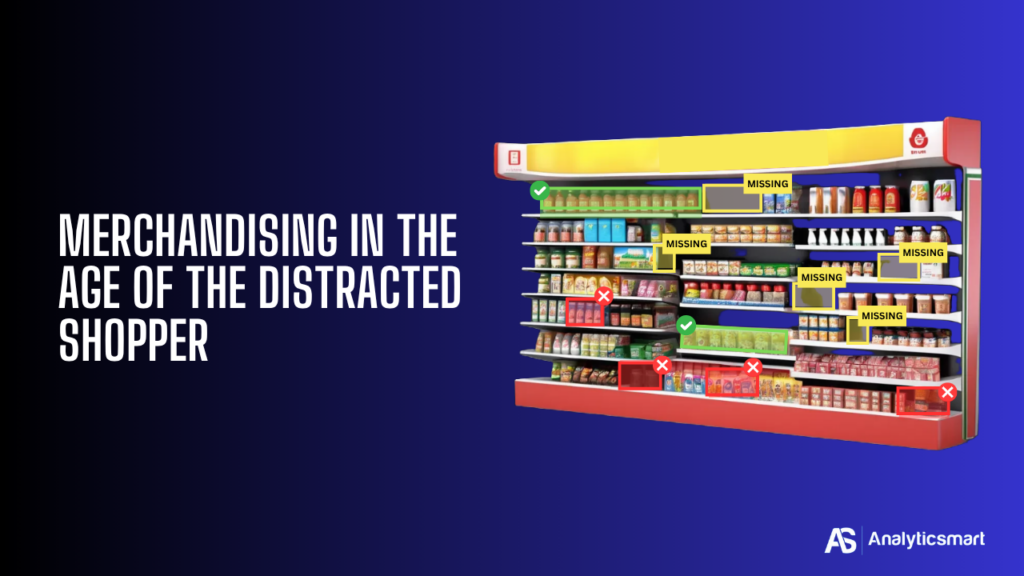
- They treat compliance as a revenue metric, not a tick-boxA planogram that exists in a software system but is never fully executed is not a strategy — it is a document. Leading retailers and suppliers track planogram compliance by store cluster and tie it directly to velocity data. Closing the compliance gap is often the single largest untapped revenue lever available without changing a single product or price.
- They use shopper data to validate eye-level principlesThe classic “eye level is buy level” rule holds — but the optimal shelf height varies by shopper demographic, store format, and product category. Organizations using sell-through analytics segmented by planogram position are making placement decisions based on what actually drives conversion in their specific context, not on industry rules from thirty years ago.
- They design visual blocking to reduce cognitive loadProducts grouped by brand, occasion, or flavor profile process faster than fragmented shelves. In CPG, this means coordinating with retailer partners on blocking strategies that make the category scannable — not just negotiating more facings for your own SKU. A cleaner shelf grows the whole category, which benefits everyone.
- They use basket affinity data to drive adjacency decisionsWhat sits next to your product shapes how it is perceived and whether it gets picked up. Cross-merchandising that is grounded in actual basket data — not historical habit or sales rep relationships — consistently outperforms. The shopper who is buying complementary products nearby is already predisposed to your category; the right adjacency converts that intent into a sale.
- They connect field activity to shelf performance dataThe highest-performing retail and CPG organizations have built a connected view between field visit frequency, planogram compliance rates, and category velocity. When a store cluster is underperforming, they can diagnose whether the issue is execution, placement, assortment, or pricing — rather than guessing or waiting for the annual business review to find out.
The data gap that is quietly costing you
Most retail and CPG organizations have more data than ever, and are using less of it than they should to make merchandising decisions. Point-of-sale data sits in one system. Planogram data — when it exists at all — sits in another. Field team visit reports are scattered across CRM notes and spreadsheets. Shopper panel data gets reviewed quarterly. None of it is connected in a way that enables fast, confident action.
The result is that shelf strategy gets set based on last season’s performance, adjusted by the loudest voice in the room, and executed inconsistently across a store estate that nobody has a real-time view of. By the time the data makes its way back to a decision-maker, the planogram cycle has already moved on.
This is not a data problem. Most organizations are drowning in data. It is a connected intelligence problem. The organizations winning at shelf are those that have built a layer of business intelligence that pulls these signals together — sell-through by SKU, compliance rates by store tier, field visit frequency against velocity metrics — and surfaces the right insight to the right person at the right time.
The shelf is still the moment that matters
For all the energy the industry has invested in digital commerce and performance marketing, the vast majority of CPG purchases still happen in physical retail. That shelf encounter — fleeting, distracted, and over in three seconds — is still the moment that determines whether you win or lose the sale.
What has changed is the context in which that moment happens. The shopper arrives more distracted, more pre-decided, and less patient than ever. The window to engage them is narrower. The competition for their attention is fiercer. Winning in that environment is not about louder or busier merchandising. It is about cleaner, smarter, and more relevant — a shelf that earns the shopper’s split-second decision.
That kind of shelf does not happen by accident. It is designed with data, executed with discipline, and optimized continuously with the right analytics infrastructure behind it.
See what your shelf data is telling you
We help retail and CPG teams connect planogram, compliance, and POS data into one clear picture — so you can act on what’s happening at shelf, not find out about it after the fact.
