The Power of a Purpose-Built CRM: How Analyticsmart Turns Field Reps Into Real-Time Revenue Drivers
Ask a beverage alcohol sales rep what slows them down most, and the answer is rarely the selling itself. It’s the paperwork that follows it. An order scribbled on a notepad that has to be re-entered back at the office. A customer visit that produces useful feedback nobody captures anywhere systematic. A route planned the same inefficient way it’s been planned for years, because nobody’s ever had the data to plan it better. A CRM built for a generic sales team, retrofitted with alcohol-specific workarounds that never quite fit the way this industry actually operates.
A CRM built specifically for beverage alcohol changes what’s possible in that gap between the field and the office — not by adding more software to the rep’s day, but by collapsing the distance between what happens on a store visit and what the business actually knows about it.
Why Generic CRMs Fall Short in This Industry
Most CRM platforms were designed around a straightforward B2B sales motion: a lead, a pipeline stage, a close. Beverage alcohol doesn’t work that way. A rep isn’t just managing a sales pipeline — they’re managing standing relationships with liquor stores, bars, and restaurants; tracking inventory levels that shift by the day; navigating route logistics across dozens of accounts; and operating inside a three-tier distribution structure where the same account might need a different type of attention depending on whether it’s off-premise retail or on-premise hospitality.
A generic CRM treats all of this as an afterthought — extra fields bolted onto a sales pipeline that was never designed for the specific rhythm of beverage alcohol field work. This is exactly the gap Analyticsmart’s CRM for beverage alcohol was built to close: a system designed around what a rep actually does in a day, not a system a rep has to bend their workflow around.
Real-Time Updates: Closing the Gap Between the Store and the System
The single biggest structural weakness in traditional field sales is the delay between an action happening in the field and that information reaching the rest of the organization. A rep takes an order at a liquor store on Tuesday; if that order doesn’t reach the system until Thursday, everyone downstream — inventory planning, distribution, the next rep visiting a related account — is making decisions on stale information for two full days.
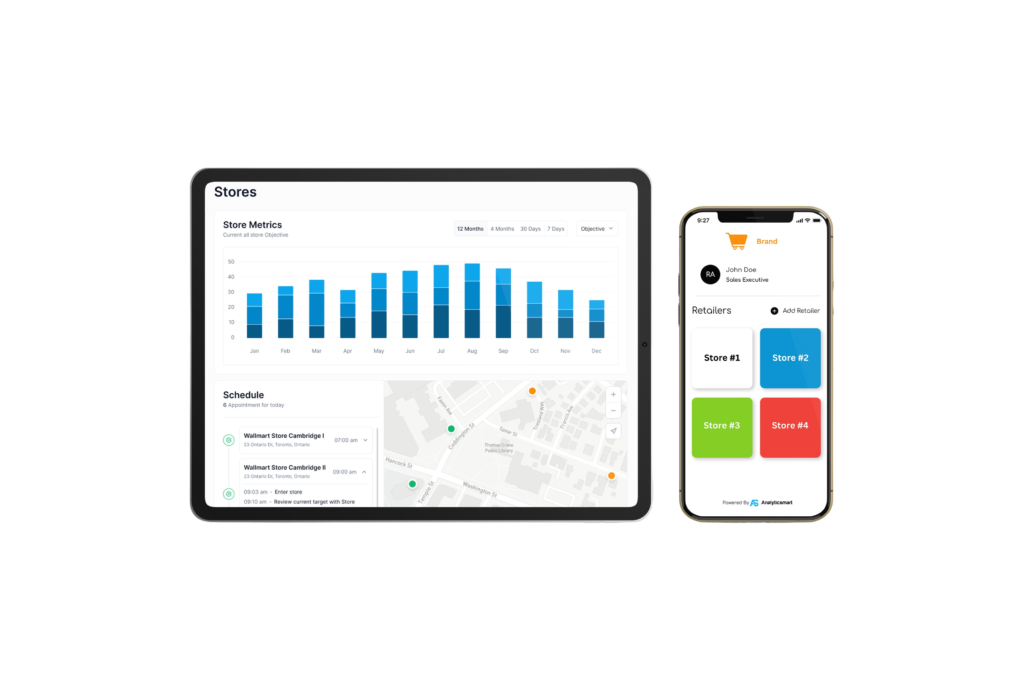
Analyticsmart’s CRM removes that delay by giving reps real-time access to inventory levels, order status, and account history directly from their mobile device, on-site. A rep walking into an account isn’t relying on memory or a printout from last week — they’re seeing current information and updating it live, which means every decision made in that conversation, on both sides of the counter, is based on what’s actually true right now, not what was true when the last report was filed.
Streamlined Order Management: Less Paperwork, More Selling
Order management is where a lot of field sales time quietly disappears. Manually tracking orders, re-entering them into a separate system, chasing down confirmation — none of it drives revenue, and all of it takes time away from the actual relationship-building and selling that does. By simplifying order tracking, submission, and processing into the same mobile tool a rep is already using in the account, Analyticsmart’s CRM shifts that time back to where it matters — letting reps spend their limited hours in front of a buyer building the relationship, not filling out a form after the fact.
Route Planning and Field Execution: Turning Field Time Into Strategic Time
Route planning sounds like a logistics detail, but in a business where reps are covering dozens of accounts across a territory, it’s a direct lever on revenue. A poorly planned route means fewer productive visits per day, more time on the road, and less attention available for the accounts that need it most. Analyticsmart’s CRM builds route optimization directly into the field execution toolkit, alongside customer insights and sales performance tracking — meaning a rep’s day isn’t just organized, it’s organized around where the data says the highest-value visits actually are.
This is field execution excellence in practice: not working harder, but directing the same finite field hours toward the accounts and activities most likely to move the business forward.
Visit Surveys and Activity Management: Capturing What Used to Get Lost
Some of the most valuable information a rep collects in the field has traditionally been the hardest to capture systematically — a buyer’s offhand comment about a competitor’s promotion, a shift in what’s actually moving off the shelf, a signal that an account relationship is cooling before it shows up in the sales numbers. Visit surveys and activity management tools give reps a structured, low-friction way to log exactly this kind of feedback during a visit, rather than relying on memory or informal notes that rarely make it back to anyone who could act on them.
Over time, this transforms account intelligence from something that lived in individual reps’ heads — and left the company whenever a rep did — into an institutional asset the whole organization can draw on.
Where the CRM Becomes More Than a CRM: Integration with BI
The feature that separates a genuinely powerful beverage alcohol CRM from a merely functional one is what happens after the data is captured. Analyticsmart’s CRM connects directly with its BI dashboard, meaning the contact history, order data, route performance, and visit feedback a rep generates in the field doesn’t sit isolated in a sales tool — it feeds directly into the same system tracking sales and distribution analytics, market and competitor insights, and inventory performance.
This integration is what turns day-to-day field activity into strategic visibility. A pattern showing up across visit surveys in a region can be cross-referenced against actual sales and depletion trends in that same region. A route optimization decision can be informed by which accounts are showing the strongest velocity in the BI dashboard, not just geographic proximity. Sales leadership gets a single, unified view instead of two disconnected systems that require manual reconciliation to tell a complete story.
Mobile by Design, Not by Retrofit
Beverage alcohol field work doesn’t happen at a desk. It happens in a liquor store aisle, at a bar during a delivery, at an event where a rep needs to check inventory on their phone between conversations. A CRM that treats mobile access as a secondary feature, layered onto a desktop-first product, tends to show the seams — slow load times, missing functionality, a workflow that assumes a keyboard and a stable connection. Analyticsmart’s CRM is built mobile-first, fully optimized for phones and tablets, so the tool works the way the job actually happens: on the go, in the account, in real time.
The Bottom Line
A CRM’s real value in beverage alcohol isn’t measured by how many fields it can track — it’s measured by how much friction it removes between a rep’s day in the field and the organization’s ability to see, understand, and act on what happened there. Real-time updates, streamlined orders, smarter routes, captured field intelligence, and a direct line into BI aren’t separate features so much as one connected idea: give the field team a tool built for how they actually work, and the entire business gets sharper, faster information as a result. In an industry built on relationships, that’s not a replacement for the human side of the job — it’s what makes every one of those relationships more informed, and every rep’s time in the field worth more.
